Short Movie:
the thief (2024)
Watch the movie here: YouTube
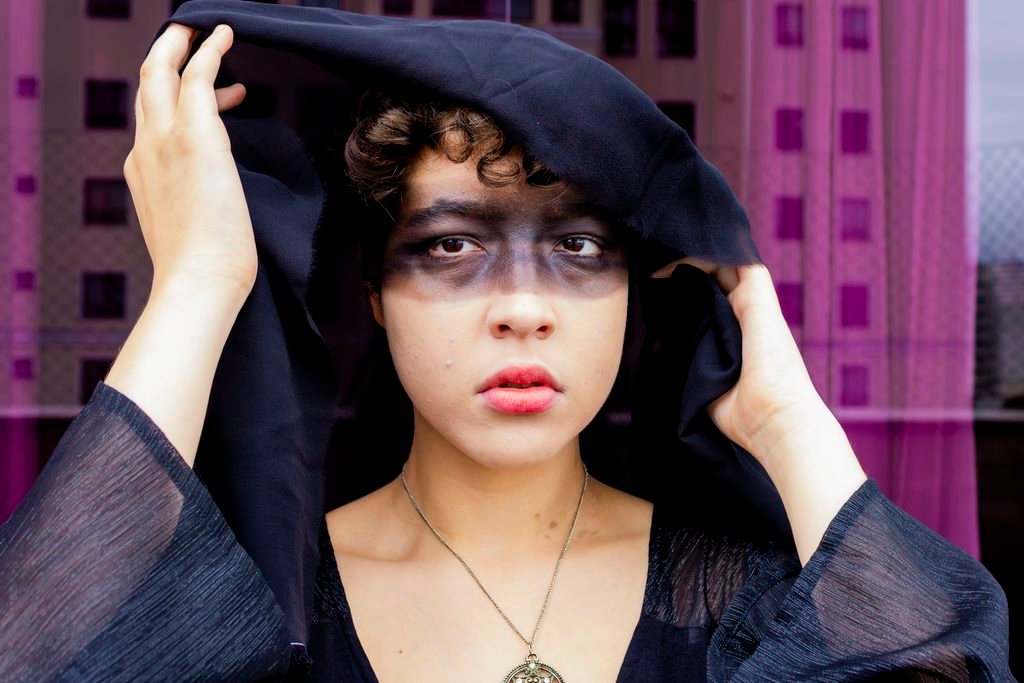
Synopsis: Through photos, we see a fight happening between the real and the imaginary throughout the movie’s whole structure; in the imagery represented, in the relationships explored and in the metalanguage that defines the characters.
Thoughts about the movie
In this next section, I’ll talk about the movie’s meaning, as well as my thoughts on it after its unofficial release. If you wish to keep your own analysis of the work, I suggest ignoring myself completely here.
The Thief was a project made for the discipline on art direction (which in english, can be called production design) on my college. As I was tasked on spending a lot of time conceptualizing different aspects of the short film’s substance, I created the concept of the thief. I would learn to evolve this concept until it was a permanent part of my “branding”, as the nickname I’d use for myself in art matters and the name of the small complex of sites I headed.1 I don’t remember if I’ve ever publicly explained why this name was chosen, so bear with me.
The thief was a concept I created, at first, for the movie. The movie’s main theme was that of the muse. When an artist loves somebody, they create a muse out of that person, a figure that will be present in the pedestals of their work for as long as the love is lingering. But beyond an artist and the concreet works he displays, everyone has an image of somebody in their heads, and when your feelings for someone are intense, may them be positive or negative, that image will never be equal to the person itself. In fact, regardless of the intensity of the feeling: your image of someone will never be the same as the real person.2 And that was the idea that I wanted to stretch out and study in the movie.
In case you don’t know, the movie was about a person that I was heavily in love at the time. I wrote countless songs about her, but one important to this subject was a song titled Canyons, the first song I wrote for her and the song that kickstarted basically all of the songs that I wrote after it. I’d love to talk more about it in a different day, but Canyons was a song that was composed and written in a very different way if compared to the songs that I wrote before it. After Canyons, every song of mine tried to not only come from a similar place, but to be as inventive as I tried to be with its melody.3 There’s nothing too complex about the song’s structure or composition, but it was the first time I wrote something and felt like an unrecognizable artist. It felt like something that would never be written by me, but it was. And ever since I tried to recapture that feeling, that feeling of creating something beyond your current capabilities.
And Canyons, even as much as I praise it and say that I do believe it to be well-written, was the first moment where I tried to represent that person I loved in my art and saw the gap (the canyon) between the image and the real. As I often told her after she discovered the song was for her, and as it was the same thing that I told her after she watched the movie as it came from a similar place, I felt I was talking more about me in some moments than I was talking about her. And that’s what images are, they’re reflections of our own person being placed in front of the real thing, and we pretend they replace the actual being itself.4 The more I reflected in Canyons during the period where I came up with the concept of the movie, the more I noticed I inferred things about her that were more attached to how I viewed her than how her life was actually lived. More and more, as soon as some art I made about her was created, I had to understand that what was being represented was always an image, even in the positive art.5
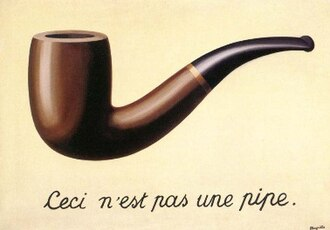
So the movie is supposed to be her confronting her image of herself I created in the art made about her. The idea, which I was very proud of at the time, was that at the end, she would explain how she actually viewed herself. The things is that you, as the viewer, understanding the movie to be a critique of the image we create of other people, need to see her doing so and know that even at that moment that is not the actual image of the actual person. Even when the character describes how she actually views herself, that is still an image the writer created of her (Magritte again).6
I like my movies and my full projects to have a thesis. To have an answer that it tries to get, and can only get at the end. The thesis of the movie (sorry for spoiling the fun of figuring it out for yourself) is that there is no reality in the perception of a movie.7 No one will ever be able to explain themselves through the art that they didn’t make about themselves. Movies are eternally ficticious, eternally biased, eternally incomplete images of reality. But something I didn’t put in the movie is that it’s not because it is an incomplete image, that it has to be a negative one. You just have to understand it is different from the real thing. And by understanding it, you can finally make art.8
- The thief talked about in my other site and the thief from the movie are different thieves. I’ll explain it on the eighth footnote. ↩︎
- Part of my interest for this idea came from a class I attended where the professor talked about that Magritte painting; the concept is the same. ↩︎
- One of the aspects I love the most about Canyons was how I composed its melody, but no one else knows how the song is sang other than me. ↩︎
- Part of this (but not the full concept) I plan to (and have kind of already done) to explore in what I wish to be my second album, A Woman Mirror; the expansion of my dependant and unhealthy view on women (the Woman Wall, women as divine beings) being reflections of my own womanhood, and how without the women in my life I wouldn’t be half the man I am. ↩︎
- The canyon was supposed to symbolize many things. Our actual physical distance, for example, being a gigantic empty space. This same space, in another moment in the song, could be a place you would scream in and be able to “fill it up” with your voice, since your voice was as big as that colossal place. It was a metaphor for the depth of human connection, as well, and the feeling of not being able to connect deeply with others. It was, of course, a metaphor about our love for each other, which the last phrase hints at. I won’t explain that last phrase much further now, but it spoke of the canyon as a metaphor for damage done; the erosion that causes a canyon, at least, and how without that destruction you won’t have the beautiful view of the canyon. It was the gentlest way I found to say that I loved her so much that that love hurt me, and I’m very proud of that line. ↩︎
- This is why I say “… and in the metalanguage that defines the characters” in the synopsis, by the way. The movie is supposed to be meta. ↩︎
- I had a lot of classes talking about documentaries, and most of them were precisely about this: the movie, even a documentary, will never be real. It always has to pass through the lens of the creator of it, making it always a different existence to the real people and events. ↩︎
- The thief, being the concept adapted for the site (and the person I talk about in my song Thief, that plays in the end of the movie without lyrics), means “a person eternally guilty of all it is accused of doing”. A thief, in this context, is not necessarily a stealer as he is in the other context (of being a stealer of one’s identity to paste in your art); he’s a prisoner, someone that needs to pay for their crimes. Pretty self-pitying, right?
Well, some things happened with a group of friends last month. I was upset, but not at them, but we were talking and they thought that by my tone I had something mean to say to them. They communicated it with me, but the difference between how I thought I was being perceived to how I actually was perceived was too big; in my head, I wasn’t mean at all. I remember I spent weeks apologizing for everything that I would say, in case I didn’t knew how I came out. Well, the thief also speaks of that. It was an old thing I used to martyr myself about: how people could think I’d say awful things about them even after so many good things I’d say. It was one of my biggest insecurities; how different the image I had of myself was to other people. In my self-hate, I then thought that everyone secretly hated me and expected the worse of me; and of course, they would all be correct because that image was correct.
This is also why I ended the site; this concept doesn’t exist anymore. After so long, after so much self-pitying, and after a lot of support from those friends (and one other special friend I talked to today), I realized the image they had of me was always very positive, and never defined by my difficult moments. I realized that the image I created of myself was not the image they had of me in their hearts, and theirs wasn’t negative as I thought. And regardless, no image is correct as in it is a faithful representation of a being. I wish to have a better image of myself in my head, so there’s no space anymore to be a thief. ↩︎